
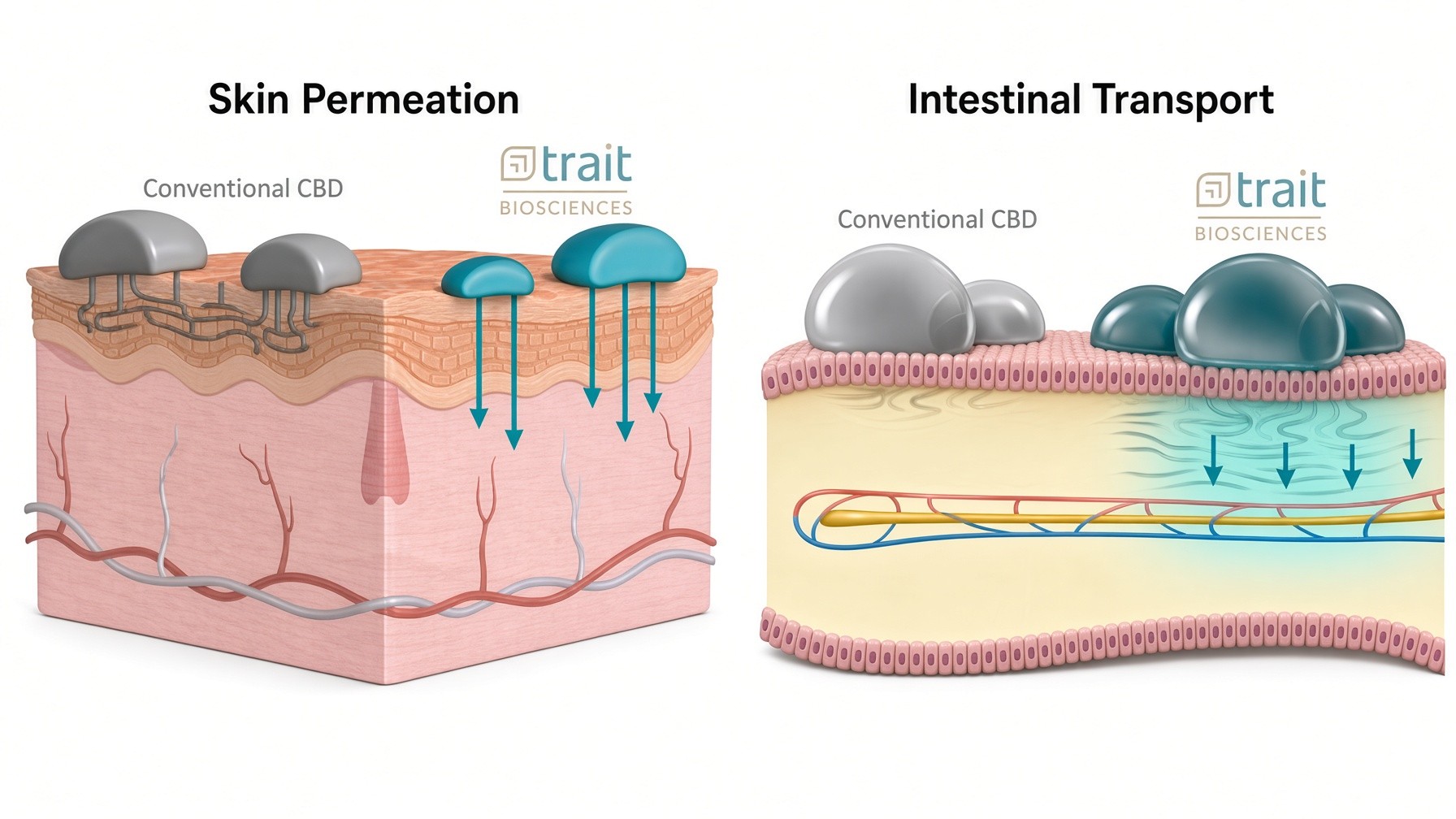
Ex-vivo findings comparing CBD82S™ with conventional CBD demonstrated substantially greater skin permeation and enhanced transport across the intestinal membrane, providing insight into how water-soluble cannabinoid molecules interact with biological barriers.
Membrane permeation is an important consideration when evaluating the delivery and potential biological activity of an active compound. For CBD, these considerations are particularly relevant because conventional CBD is naturally lipophilic and water-insoluble.
Trait Biosciences’ studies demonstrated that CBD82S™ permeated and was transported across the membranes evaluated at substantially greater levels than conventional CBD under the conditions tested. The studies do not establish the molecular mechanism responsible for this difference, and additional research is needed to understand how CBD82S™ moves across biological barriers.
Enhanced Membrane Permeation
In ex-vivo models, CBD82S™ demonstrated substantially greater permeation and transport across biological membranes compared with conventional CBD.
Key findings included:
- Over 100-fold greater skin permeation under the conditions tested
- Enhanced transport across the intestinal membrane
These results indicate that CBD82S™ behaved differently from conventional CBD in the membrane models evaluated.
Why Membrane Permeation Matters
Biological barriers can influence how an active compound reaches its intended environment. For oral delivery, transport across the intestinal membrane is one factor involved in movement from the gastrointestinal tract toward systemic circulation. For topical applications, skin permeation is an important consideration for delivery into relevant skin layers.
Demonstrating membrane permeation can therefore be an important step in evaluating the delivery characteristics of an active compound. The ability of a compound to permeate a biological barrier may make it available for subsequent interaction with biological systems, although membrane permeation alone does not establish absorption, biological activity, or clinical efficacy.
Skin Permeation
The skin is a complex biological barrier that can limit the movement of active compounds.
In the ex-vivo model evaluated, CBD82S™ demonstrated over 100-fold greater permeation through the skin compared with conventional CBD under the conditions tested.
This finding supports further investigation of CBD82S™ for applications where delivery into or across the skin is an important consideration. Additional studies are needed to determine how these ex-vivo findings translate to specific formulations and biological outcomes.
Intestinal Membrane Transport
For orally administered compounds, the intestinal membrane represents an important barrier to absorption.
CBD82S™ demonstrated enhanced transport across the intestinal membrane compared with conventional CBD in the ex-vivo studies.
These findings provide additional insight into the transport characteristics of CBD82S™ and support continued research into its potential role in oral cannabinoid delivery. However, ex-vivo membrane transport is not a direct measure of human oral bioavailability. Trait Biosciences continues to conduct studies to evaluate absorption, systemic exposure, and pharmacokinetic performance.
What the Findings Mean for Cannabinoid Development
CBD’s lipophilic and water-insoluble nature can create formulation and delivery challenges, particularly in aqueous environments. CBD82S™ was innovated through Trait Biosciences’ proprietary technology platform to provide a water-soluble cannabinoid molecule with distinct physicochemical properties.
The observed differences in membrane permeation and transport provide a basis for investigating how these properties may influence cannabinoid delivery.
For development programs, membrane behavior is one consideration alongside formulation, absorption, metabolic stability, bioavailability, and pharmacokinetics. The current ex-vivo findings do not establish that water solubility alone accounts for the observed differences, nor do they establish the molecular mechanism of membrane transport or predict clinical outcomes.
Looking Ahead
The membrane findings add to Trait Biosciences’ broader research into CBD82S™.
In a human liver microsome model, CBD82S™ demonstrated an approximately 25-fold longer apparent half-life than conventional CBD under the conditions evaluated.
Together, these studies provide experimental findings on how CBD82S™ behaves in different biological models. Further research will help determine the mechanisms underlying the observed membrane behavior and how the observed membrane permeation and transport translate to in-vivo absorption, tissue exposure, systemic exposure, and overall pharmacokinetic performance.
For additional information on the study, including study design, methodology, and detailed findings, please contact Trait Biosciences at info@traitbio.com.