
Cannabidiol (CBD) has attracted interest for its role in supporting comfort, neural function, and stress regulation. However, its poor water solubility and high lipophilicity can limit effective delivery and absorption.
Trait Biosciences has developed CBD82S, its lead pharma-grade, water-soluble, single-molecule CBD derivative (prodrug API). Trait’s CBD prodrugs are innovated to transform conventional water-insoluble CBD into forms that dissolve readily in aqueous environments, creating new possibilities for drug formulation and biological performance.
Building on Established CBD Approaches
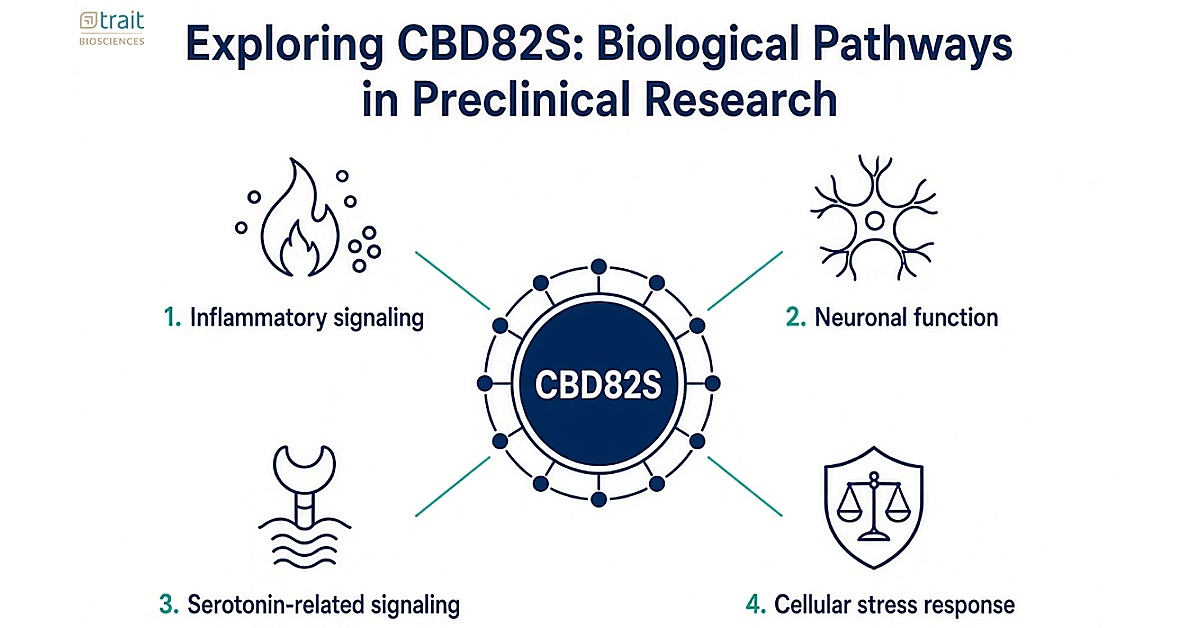
Trait’s CBD82S is a CBD derivative with enhanced aqueous solubility and reduced lipophilicity, innovated to overcome key delivery limitations of conventional CBD. In preclinical mouse studies, following multiple intraperitoneal (i.p.) doses (80 mg/kg per dose), CBD82S demonstrated positive effects across inflammatory, neuronal, serotonin-related, and stress-response pathways. The combination of improved water solubility and these preclinical findings gives Trait’s CBD82S a differentiated profile relative to conventional CBD.
Inflammatory Signaling
In preclinical models, CBD82S was associated with reduced expression of key pro-inflammatory genes involved in neuroinflammation and pain sensitization. These findings suggest a potential role in dampening inflammatory signaling that contributes to discomfort and heightened pain sensitivity. By modulating genes linked to these processes, Trait’s technology offers a differentiated approach to supporting pathways that influence tissue-level inflammatory regulation.
Neuronal Function
Additional work examined the effects of CBD82S on genes involved in neural plasticity, signaling, and excitability. CBD82S was associated with a shift in the expression of a key neuroplasticity-related gene toward healthy-control levels, alongside reduced expression of a gene connected to pain-related neuronal activation. These findings suggest that CBD82S may help regulate pathways involved in neuronal communication, adaptation, and responses to stress.
Serotonin-Related Signaling
Trait’s research has also evaluated the effects of CBD82S on genes associated with serotonin-related signaling. CBD82S was associated with increased expression of a serotonin receptor gene in brain tissue, suggesting a potential influence on pathways involved in mood, anxiety, and pain regulation.
Stress-Response Signaling
Trait’s research also examined the effects of CBD82S on genes involved in stress-response signaling. Stress-response pathways help regulate how the brain and body adapt to physiological and psychological stress, including stress associated with chronic pain. Changes in this area, when considered alongside the serotonin receptor gene expression findings, suggest how water-soluble CBD may positively influence pathways involved in stress and anxiety regulation.
The observations described are based on preclinical studies. Additional research and clinical evaluation are needed to determine safety, pharmacokinetics, efficacy, and potential therapeutic benefits in patients.
To learn more about Trait’s technology and explore collaboration opportunities, contact info@traitbio.com.